How to Watch Polo: A Spectator's Complete Guide
Everything you need to know before attending your first polo match — from understanding the rules to dress codes and spectator etiquette.
How to Watch Polo: A Spectator's Complete Guide
Your first polo match can be confusing without guidance. Horses thunder past, players swing mallets at alarming speeds, and the ball seems to disappear into the expanse of the field. But with a little understanding, polo becomes captivating — the athleticism, the partnership between horse and rider, the strategic complexity.
Here's everything you need to know before attending your first match.
Understanding the Basics
The Objective
Each team attempts to score goals by hitting the ball through the opposing team's [goal](/glossary/goal) posts. Simple enough — the complexity lies in the execution.
The Field
**Dimensions**: 300 yards long × 160 yards wide — about nine times the size of a football field. This is the largest playing field in organized sport.
**Goal Posts**: 8 yards apart, positioned at each end of the field.
**The Boards**: Low [sideboards](/glossary/sideboards) run along the sidelines, keeping the ball in play and allowing bank shots.
The Teams
**Four Players Per Side** (in outdoor grass polo):
Match Structure
**Chukkas**: Games consist of 4-6 chukkas (periods), each lasting 7.5 minutes of play time.
**Breaks**: Brief breaks between chukkas; longer halftime (typically after 3rd or 4th [chukka](/glossary/chukka)) when spectators are invited onto the field.
**Team Switches**: Teams change ends after each goal to neutralize any wind or sun advantage.
The Rules You Need to Know
The [Line of the Ball](/glossary/line-of-the-ball)
The most important concept in polo. When a player hits the ball, an imaginary line extends along its path. This "line of the ball" determines right of way:
Fouls and Penalties
Common fouls include:
**Penalty Shots**: Awarded for fouls, ranging from [Penalty 1](/glossary/penalty-1) (automatic goal) to Penalty 5 (free hit from midfield). The severity depends on where the foul occurred and how dangerous it was.
Handicaps
Players carry individual handicaps from -2 (beginner) to 10 (world-class). Most countries have only a few 10-goal players; it's the sport's equivalent of a black belt.
**Team [Handicap](/glossary/handicap)**: The sum of the four players' handicaps. High-goal polo (22+ goals) features the sport's elite; most amateur competition is 4-12 goals.
What to Wear
Polo dress codes vary by venue and event. General guidelines:
For Standard Club Matches
**Women**: Sundresses, elegant casual wear, wedges or heels (bring flats for halftime field walking)
**Men**: Collared shirts, chinos or smart casual trousers, loafers or leather shoes
For Major Tournaments
Dress codes elevate for prestigious events. Check the venue's guidelines, but expect:
**Women**: Cocktail dresses, statement hats, heels
**Men**: Blazers, dress shirts, possibly suits for VIP areas
Practical Considerations
The Social Ritual
Polo matches follow expected social patterns:
Arrival
Arrive at least 30 minutes before the first chukka for good positions and to settle in.
Between Chukkas
Short breaks for horse changes. Use this time to refresh drinks, socialize, adjust your position.
Halftime: [Divot](/glossary/divot) Stomping
The signature polo tradition. Spectators are invited onto the field to stomp down divots (chunks of turf) kicked up during play. It's functional (prepares the field for the second half) and social (mingle, take photos, stretch your legs).
**Etiquette**: Spread out across the field, actually stomp divots (not just wander), return to the sidelines promptly when players reappear.
After the Match
Most venues offer post-match socializing. Award presentations, conversations with players, champagne toasts — this is part of the polo experience.
Where to Watch
From the Sidelines
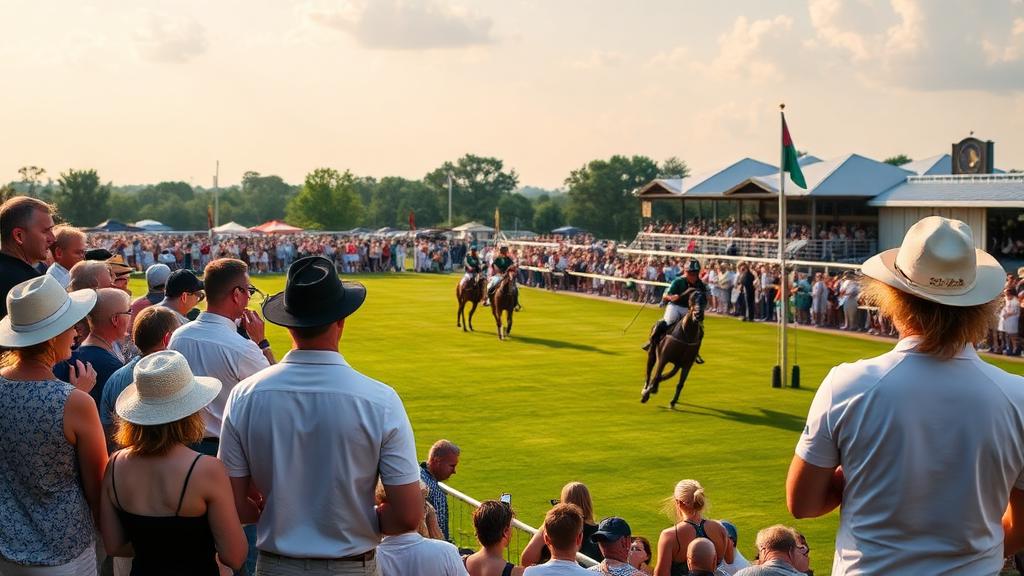
Most spectators watch from the sidelines behind the boards. You'll be close to the action when play comes your way. Move along the sideline to follow play if permitted.
VIP and Hospitality Areas
Major events offer ticketed hospitality with:
General Admission
Many clubs offer free general admission. Bring blankets, chairs, and picnics.
Following the Action
Watch the Ball
Easier said than done — the ball is small and fast. Tips:
Watch the Horses
If you lose the ball, watch the horses. Their positioning tells you where the play is developing.
Watch the Strategy
As you become comfortable, notice:
Photographing Polo
Polo is highly photogenic. Tips for good shots:
**Position**: Near goal posts captures scoring action; sideline captures speed.
**Equipment**: Long telephoto lenses work best (200mm+). Phone cameras capture atmosphere but struggle with action detail.
**Timing**: Afternoon light (golden hour) creates the best images.
**Subjects**: Action shots are exciting, but don't forget portraits of horses, players, spectators, and atmospheric details.
**Permission**: At some events, professional photography requires media credentials. Personal photography is generally welcome.
Etiquette Summary
**Do**:
**Don't**:
Understanding What You're Watching
Good Polo vs. Great Polo
**Good Polo**: Clean hitting, controlled horses, minimal dangerous play.
**Great Polo**: All the above plus:
What to Appreciate
**Horsemanship**: The partnership between rider and horse is the sport's essence.
**Risk Management**: Players constantly balance aggression with safety.
**Athletic Combination**: Polo demands riding skill, hand-eye coordination, strategic thinking, and courage simultaneously.
**The Horses**: These are elite athletes in their own right. Watch how they stop, turn, accelerate — their athletic ability is extraordinary.
Where to Start
Entry-Level Viewing
**Club Practice Chukkas**: Many clubs host weekly chukkas open to spectators. Low-pressure way to learn the sport.
**Lower-Level Tournaments**: 4-8 goal polo is often more accessible than high-goal events and still features good play.
Bucket List Events
Once comfortable with the sport:
The Spectator Journey
Most people attend their first polo match for the social experience and leave intrigued by the sport. The path typically follows:
1. **First Match**: Social curiosity, basic rule understanding
2. **Return Visits**: Growing appreciation for skill and strategy
3. **Following Players/Teams**: Developing favorites
4. **Tournament Attendance**: Seeking the best competition
5. **Playing Interest**: Many spectators eventually try lessons
Polo rewards sustained attention. The more you watch, the more you appreciate. And unlike many sports, polo welcomes newcomers with exceptional hospitality.
Come for the champagne. Stay for the sport.