Polo Eyewear: Why Sunglasses and Sports Glasses Matter
Eye protection and glare control are underappreciated performance factors in polo — the right eyewear protects against injury and improves ball tracking in varying light conditions.
Polo Eyewear: Why Sunglasses and Sports Glasses Matter
Of all the equipment decisions a polo player makes, eyewear is perhaps the most frequently neglected. Many players ride without eye protection of any kind, or make casual sunglasses choices that are unsuitable for the demands of polo. This is a genuine gap — both in safety and performance.
A polo ball travelling at speed, a raised [mallet](/glossary/mallet), grass fragments from divots, and intense summer glare are all hazards that appropriate eyewear addresses. This guide covers the case for polo eyewear, the types available, what to look for in a suitable lens, and how to integrate eyewear with a helmet. For a complete overview of polo safety equipment, see our [polo safety](/equipment) guide.
The Case for Eye Protection in Polo
Impact Risk
A polo ball is a solid plastic or wood sphere approximately 3.5 inches in diameter and weighing 3.5 to 4.5 ounces (depending on whether it is practice or tournament specification). At full match pace, the ball travels at speeds that make any direct eye impact potentially blinding. While the probability of a direct face impact in any given chukker is low, it is not negligible — particularly in [arena polo](/glossary/arena-polo), where the confined space and boarded sides create more opportunities for ball trajectories that surprise players.
A polo mallet at the top of a backswing is at approximately head height. Mallet-to-face contact is a recognised injury mechanism in polo, particularly during close-marking situations. The face is the least protected part of the body in standard polo equipment.
Glare and Vision Performance
The second, more commonly experienced argument for polo eyewear is glare management. Polo is played predominantly outdoors, often in strong sunlight, on grounds that can have significant glare from:
Tracking a polo ball against a bright sky or into the sun is a fundamental polo skill — and unmanaged glare compromises it significantly. Players without adequate sun protection consistently underperform their potential in high-glare conditions. The ball is lost in the glare at exactly the moments when tracking it matters most.
UV Protection and Long-Term Eye Health
Regular outdoor participation in summer conditions without UV eye protection contributes to cumulative UV-related eye damage — including conditions such as photokeratitis (snow blindness equivalent from grass reflection), cataracts, and macular degeneration over a career. This is a long-term consideration, but it is real.
Types of Eyewear Suitable for Polo
Wraparound Sports Sunglasses
The most common choice for polo. Wraparound frames provide peripheral coverage that standard flat-front sunglasses do not, protecting against side glare and impact from angles outside the direct front. Key features to look for:
**Frame material**: Lightweight TR90 nylon or similar flexible polymer. Avoid heavy frames that create discomfort under a helmet or bounce during riding.
**Lens coverage**: Full coverage from browline to cheekbone. Gaps at the top or sides allow glare to enter around the lens, negating much of the benefit.
**Nose grip**: Rubberised or anti-slip nose pieces are essential — sweat from riding causes standard nose pieces to slide constantly.
**Lens width**: Wide enough to cover the full visual field. Narrow fashion sunglasses are insufficient.
Photochromic (Transition) Lenses
Photochromic lenses darken in bright sunlight and lighten in shade or overcast conditions. For polo, where matches may move from full sun to tree shadow, or where conditions change between chukkers, photochromic lenses eliminate the need to swap glasses. The limitation is response time — photochromic lenses take 30–90 seconds to transition, which can create a brief period of sub-optimal tint when moving rapidly between light conditions.
Modern photochromic lenses transition significantly faster than earlier generations. Look for polo-appropriate photochromic lenses that go from clear (or very light tint) to a polo-appropriate VLT (visible light transmission) of 15–25% in full summer sun.
Polarised Lenses
Polarised lenses eliminate horizontal glare — particularly effective for glare reflecting from wet ground, water, or highly reflective surfaces. In polo, polarised lenses:
The debate about polarised lenses for sport is ongoing. Some players find that polarisation interferes with depth perception slightly — a consideration for ball tracking at high speed. Test both polarised and non-polarised options before committing.
Prescription Sports Glasses
Players who require vision correction for accurate ball tracking face specific challenges. Options include:
**Contact lenses plus standard sports sunglasses**: The most common solution. Soft contact lenses with UV protection on top, covered by wraparound sports sunglasses. The combination provides optimal vision and eye protection.
**Prescription sports sunglasses**: Prescription lenses in a polo-appropriate wraparound frame. More expensive than the contact lens combination and requires prescription-specific frames, but eliminates the contact lens management challenge.
**Prescription goggles**: Not traditional in polo but used by some players, particularly in arena polo. Goggles provide more complete coverage than glasses but can fog during intense riding.
Lens Tint Colours for Polo
The tint colour of a lens affects how the world looks and how different objects — including the polo ball — are perceived against various backgrounds.
**Grey/neutral tint**: Most faithful to natural colour. The standard choice for accurate colour perception and ball tracking. Suitable for all light conditions above 15,000 lux.
**Amber/brown tint**: Enhances contrast against green backgrounds. Particularly useful for tracking the ball on grass. Many polo players prefer amber lenses for standard play conditions.
**Yellow/orange tint**: Enhances contrast in low-light or overcast conditions. Very useful for early morning or late afternoon matches. Not suitable for bright full-sun conditions.
**Rose/red tint**: Similar to amber in contrast enhancement. Some players prefer this for the specific tonal quality it produces on polo grounds.
**Green tint**: Provides good colour neutrality with some contrast enhancement. A middle ground between grey and amber.
For most polo players playing in daylight conditions, an amber or brown tinted lens in the 15–25% VLT range is the most versatile starting choice.
Integrating Eyewear with a Polo Helmet
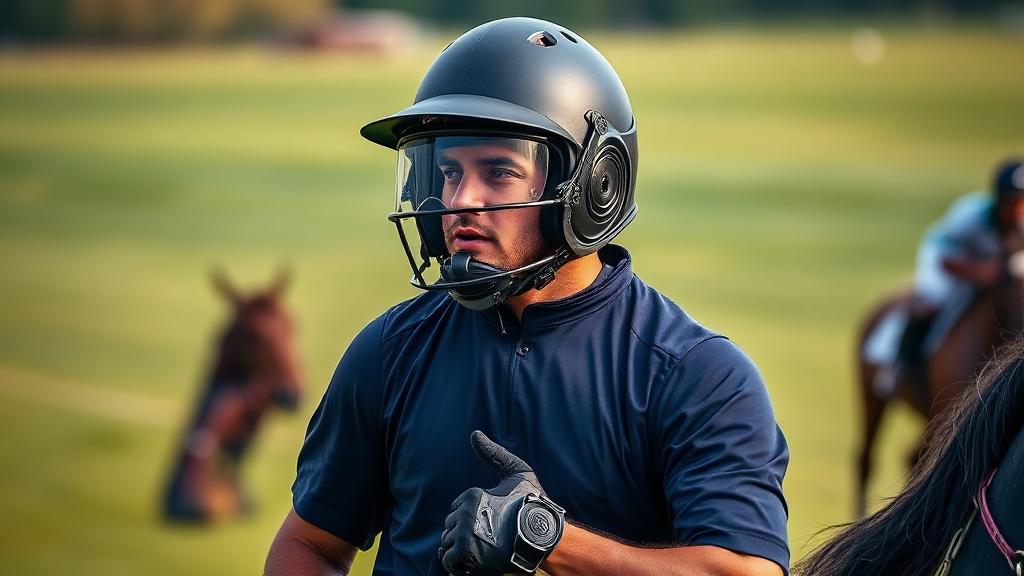
The polo helmet sits forward on the brow with a brim that shades the eyes to some degree. This creates a fit challenge for some eyewear:
**Frame temple length**: The arms of the glasses must fit between the head and the helmet interior liner. Narrow, flexible temples work best. Very wide or rigid temples create pressure points under the helmet.
**Frame height**: The top of the lens should not press against the underside of the helmet brim. Try your specific helmet with any glasses before purchasing.
**Helmet straps**: The chin harness should not interact with the frame — ensure the frame sits inside the helmet and the harness can be adjusted without affecting the glasses position.
**Retention**: Active riding creates vibration and occasional jolts that can dislodge glasses. Glasses retention straps (such as Croakies or similar sports retainers) are highly recommended to prevent glasses from falling inside the helmet or off the face during play.
What to Avoid
**Fashion sunglasses**: Frame designs for fashion rather than sport typically have minimal lens coverage, no grip features, and inadequate impact resistance. They provide poor glare protection and are not suitable for polo.
**Glass lenses**: Avoid any sports eyewear with glass lenses. Glass shatters on impact; polycarbonate and similar materials flex. Shattered glass in an impact scenario converts a manageable eye injury into a potentially catastrophic one.
**Frames with metal protruding parts**: Sharp metal edges or decorative elements near the lens are a hazard in the event of an impact. Stick to smooth-profile sports frames.
**Lenses that are too dark**: Very dark lenses (VLT below 10%) impair vision in any less-than-full-sun condition. As clouds pass over or you move into shade, tracking the ball becomes more difficult. Aim for the 15–25% VLT range for standard polo conditions.
Recommended Lens Specifications for Polo
Cost and Brands
Polo-appropriate sports eyewear is available across a wide price range:
**Budget tier (£20–£50)**: Adequate wraparound sports sunglasses with polycarbonate lenses from sporting goods retailers. Meet the basic requirements but may lack refinement in fit and lens quality.
**Mid-range (£50–£150)**: Brands such as Bolle, Tifosi, or Nike Vision offer polo-appropriate wraparound designs with better lens technology and more frame options.
**Premium tier (£150–£400+)**: Oakley, Rudy Project, and similar premium sports brands offer the best lens clarity, fit customisation, and impact resistance. Prescription options are available. For regular tournament players, the premium tier is a worthwhile investment.
Frequently Asked Questions
Are sunglasses compulsory for polo?
No — neither national associations nor most clubs require sunglasses for play. The decision is discretionary. The argument for wearing them is a combination of safety and performance, not regulation compliance.
Do polo helmets with visors eliminate the need for sunglasses?
Very few polo helmets are available with visors. Those that exist are rare and non-standard. For practical purposes, the helmet provides no glare protection beyond the brim shading the eye from directly overhead sun. Sunglasses remain the standard solution.
Can I wear contact lenses during polo matches?
Yes. Contact lenses are widely used by polo players. They are compatible with standard sports sunglasses. The primary risk to be aware of is dust and grass particles — playing in dusty conditions with contacts can cause irritation. Wrap-around lenses that seal close to the face help reduce this risk.
What if my glasses fog up during play?
Fogging occurs when warm air from breathing is trapped under the lens. Look for lenses with anti-fog coating. Also ensure the glasses frame design allows some airflow — fully sealed goggles fog more readily than open-frame sports glasses.
Should I use the same glasses for arena and grass polo?
The same glasses are typically suitable for both. Arena polo is often played in lower-light conditions (indoor or covered arenas), which may argue for a lighter tint or photochromic lens.
What happens if my glasses break during a match?
Stop play if the glasses break in a way that leaves glass or sharp fragments near the eye. Modern polycarbonate lenses do not shatter dangerously, but a cracked frame should be removed. Keep a spare pair in your kit bag.