Polo Helmet Brands Compared: Charles Owen, Casablanca, Krone, IRH, Trooper
A detailed comparison of the leading polo helmet brands, covering safety ratings, fit profiles, ventilation, and value across Charles Owen, Casablanca, Krone, IRH, and Trooper.
Polo Helmet Brands Compared: Charles Owen, Casablanca, Krone, IRH, Trooper
The polo helmet is the single most important piece of safety equipment a player owns. In a sport played at speeds of up to 35 mph with wooden mallets swinging at waist height and a compressed ball travelling at over 100 mph in top-level play, head protection is not optional — it is the line between a minor incident and a catastrophic one.
Yet choosing a polo helmet involves real complexity. The brands available vary significantly in safety certification, fit geometry, material construction, ventilation, durability, and price. This guide provides an honest, thorough comparison of the five most widely used polo helmet brands in the English-speaking polo world: Charles Owen, Casablanca, Krone, IRH, and Trooper. For a complete overview of all safety equipment requirements, see our [polo safety](/equipment) guide.
Safety Standards: What the Certifications Mean
Before comparing brands, it is essential to understand the certification landscape. Polo helmets are certified under different standards depending on the country and association.
Key Certifications
**ASTM F1163**: The American standard for equestrian helmets, administered by the American Society for Testing and Materials. Most major polo associations in the United States (USPA) require this or an equivalent standard.
**EN 1384**: The European standard for equestrian helmets. Required by British and European polo associations for club and tournament play.
**PAS 015**: A UK-specific standard that exceeds EN 1384, administered by the British Standards Institution. Many UK polo associations require PAS 015 for tournament play.
**SNELL E2016**: The SNELL Memorial Foundation's equestrian helmet standard, regarded as one of the more rigorous independent certifications.
**HPA (Hurlingham Polo Association) approved list**: The UK's governing body maintains an approved helmet list. Ensure any helmet used in HPA-sanctioned competition appears on the current HPA approved list — this list is updated periodically as standards evolve.
All helmets discussed in this guide carry at least one major certification. Always verify that the specific model (not just the brand) is currently approved by your national polo association before purchasing.
Charles Owen
Charles Owen is the most widely recognised name in polo helmets globally, and for good reason. The Welsh manufacturer has been producing equestrian helmets since 1911 and polo-specific helmets for decades.
Key Models for Polo
**Charles Owen GR8**: The GR8 is the flagship polo helmet and the most common choice among professional and advanced amateur players worldwide. It is a brim-forward design with a traditional polo aesthetic, available in a range of shell sizes and colours. Certifications include PAS 015, ASTM F1163, and EN 1384.
**Charles Owen Polo Original**: The entry-level Charles Owen option, more affordable than the GR8. Carries PAS 015 and ASTM certifications. A practical choice for club players not yet committing to the premium option.
Fit Profile
Charles Owen helmets are generally described as a medium-oval head shape. Players with very round or very narrow head shapes may find the fit less ideal without adjustments. The brand offers multiple shell sizes within each model, which allows better fit customisation than single-shell brands.
Ventilation
The GR8 has modest ventilation — adequate for most conditions but not the most breathable helmet in this comparison. Players in hot climates report this as a consideration.
Durability and Lifespan
Charles Owen helmets are regarded as among the most durable available. The brand recommends replacement after any significant impact and has a published replacement-after-impact policy. Standard lifespan without impact damage is typically 5 years, after which safety certification should be considered expired.
Price Range
**Charles Owen GR8**: £180–£260
**Charles Owen Polo Original**: £120–£160
Casablanca
Casablanca is the Argentine-origin brand that has become the dominant choice among Argentine professionals and is widely used across South America, Europe, and the USA.
Key Models for Polo
**Casablanca Polo Helmet (standard)**: The core Casablanca polo helmet is a traditional-profile helmet with a distinctive matte or gloss finish. It is available in ASTM F1163 and EN 1384 certified versions.
**Casablanca Pro**: The premium version with upgraded liner materials and improved fit system.
Fit Profile
Casablanca helmets are generally described as fitting a slightly more oval (longer front-to-back) head shape compared to Charles Owen. Players with slightly longer oval heads frequently prefer Casablanca. Argentine players in particular find the fit profile well-matched to their average head shape.
Ventilation
Casablanca helmets offer reasonable ventilation. The Pro version has slightly improved airflow compared to the standard model.
Value Proposition
Casablanca is widely regarded as excellent value for money — particularly the standard model, which provides strong safety certification at a lower price point than the Charles Owen GR8. Many club players find Casablanca to be the best combination of quality and cost.
Price Range
**Casablanca standard**: £90–£140
**Casablanca Pro**: £150–£200
Krone
Krone is a German-engineered helmet brand that has built a strong reputation in European polo, particularly in Germany, Austria, Switzerland, and increasingly in the UK.
Key Models for Polo
**Krone Polo**: The primary Krone polo-specific model. It carries EN 1384 and PAS 015 certifications and is on the HPA approved list.
Fit Profile
Krone is often cited as one of the best-fitting helmets for players with round head shapes — a head profile less well-served by some of the Argentine-origin brands. The interior padding system is customisable, allowing better adaptation to individual head geometry.
Construction
Krone uses an ABS outer shell with a multi-density EPS foam liner — a construction broadly comparable to the leading competitors. What distinguishes Krone is the attention to interior comfort padding, which is often praised as superior to more spartan competitors.
Ventilation
Krone polo helmets have good ventilation channels relative to comparable models — a useful consideration for summer tournament play.
Price Range
**Krone Polo**: £160–£210
Krone helmets can be harder to source outside Europe — check specialist UK polo retailers or import directly from Germany.
IRH
IRH (International Riding Helmets) is a US-based brand with a strong presence in American polo, particularly at the club and beginner level.
Key Models for Polo
**IRH Elite**: The primary polo-appropriate model. Carries ASTM F1163 certification and is approved for USPA play.
**IRH ATH**: An all-terrain helmet marketed for multiple equestrian disciplines including polo.
Fit Profile
IRH is often described as fitting an intermediate to slightly round oval shape. The brand is well-regarded in North America for accessibility and fit across a range of head shapes.
Value and Accessibility
IRH is one of the most competitively priced certified polo helmets available in North America. For beginners in the USA purchasing their first helmet, IRH represents a practical entry point before committing to premium brands.
Limitations
IRH helmets are less common in UK and European club polo. They carry ASTM certification but may not appear on the HPA approved list for UK tournament play — always verify before purchasing for use in HPA-sanctioned events.
Price Range
**IRH Elite**: $90–$130 USD
Trooper
Trooper is a US-based brand that has grown steadily in the American polo market, known for a traditional polo helmet aesthetic at accessible price points.
Key Models for Polo
**Trooper Polo Helmet**: The core model, carrying ASTM F1163 certification. Designed specifically for polo with a traditional silhouette.
Fit Profile
Trooper helmets fit a medium-oval head shape. The brand produces helmets at a relatively limited range of shell sizes compared to Charles Owen or Casablanca — this can affect fit quality for players at the extremes of the size range.
Market Position
Trooper is primarily a North American market product. It is rarely seen at UK or European polo clubs. For American club players seeking a traditional-looking, certified polo helmet at a budget-friendly price, Trooper is a legitimate option.
Price Range
**Trooper Polo Helmet**: $80–$120 USD
Side-by-Side Comparison
| Brand | Price Range | Key Certifications | Best For |
|-------|-------------|-------------------|----------|
| Charles Owen GR8 | £180–£260 | PAS 015, ASTM, EN 1384 | Professional/advanced players, all markets |
| Casablanca Pro | £150–£200 | ASTM, EN 1384 | Value-conscious players, oval head shapes |
| Krone Polo | £160–£210 | PAS 015, EN 1384 | European players, round head shapes |
| IRH Elite | $90–$130 | ASTM | US beginners, budget-conscious |
| Trooper Polo | $80–$120 | ASTM | US club players, traditional aesthetic |
Helmet Fit: Why Brand is Secondary to Individual Fit
The most important factor in helmet selection is individual fit — a premium helmet that fits poorly provides less protection than a budget helmet that fits perfectly. The key fit checks:
**No lateral movement**: The helmet should not rock left or right when the harness is fastened. If it does, the shell size is too large.
**No fore-aft movement**: The helmet should not slide forward or backward on the head. Lateral pads can adjust this within limits.
**No pressure points**: After 20 minutes of wear, no specific pressure points should be evident. Some initial firmness is normal; painful pressure is not.
**Harness contact**: The harness should contact the chin without being tight enough to restrict breathing or swallowing.
**The two-finger rule**: You should be able to fit two fingers — not more — between the harness and your chin when the mouth is closed.
Whenever possible, try helmets in person before purchasing. For guidance on other protective equipment, see our [polo safety](/equipment) resources.
Helmet Maintenance and Replacement
All polo helmets have a limited lifespan:
Frequently Asked Questions
Which polo helmet brand is most widely used professionally?
Charles Owen and Casablanca are the two most widely used brands at the professional level internationally. In Argentina and South America, Casablanca is dominant. In the UK, USA, and Australia, Charles Owen is most commonly seen among top-level players, though Casablanca is also widely used.
Can I use any riding helmet for polo, or does it need to be polo-specific?
Technically any helmet meeting the required certification standard is legal for polo. In practice, polo-specific helmets have design features — particularly the forward brim and lower rear profile — that are better suited to the playing position. Cross-country and show jumping helmets are sometimes used by beginners; they are safe but not optimally designed for polo.
What certification does the HPA require in the UK?
The HPA requires helmets on its current approved list for sanctioned competition. This list includes helmets meeting PAS 015 or equivalent standards. Always check the current HPA approved list rather than relying on brand claims — the list is updated as certifications change.
Do polo helmets protect against the ball?
Polo helmets are designed to withstand impact from mallets and ground impact in falls. They provide significant protection against a polo ball strike, though no helmet can guarantee protection against all possible impacts. The risk of ball impact to the head is relatively low compared to ground impact in falls.
Should I buy a helmet with or without a face guard?
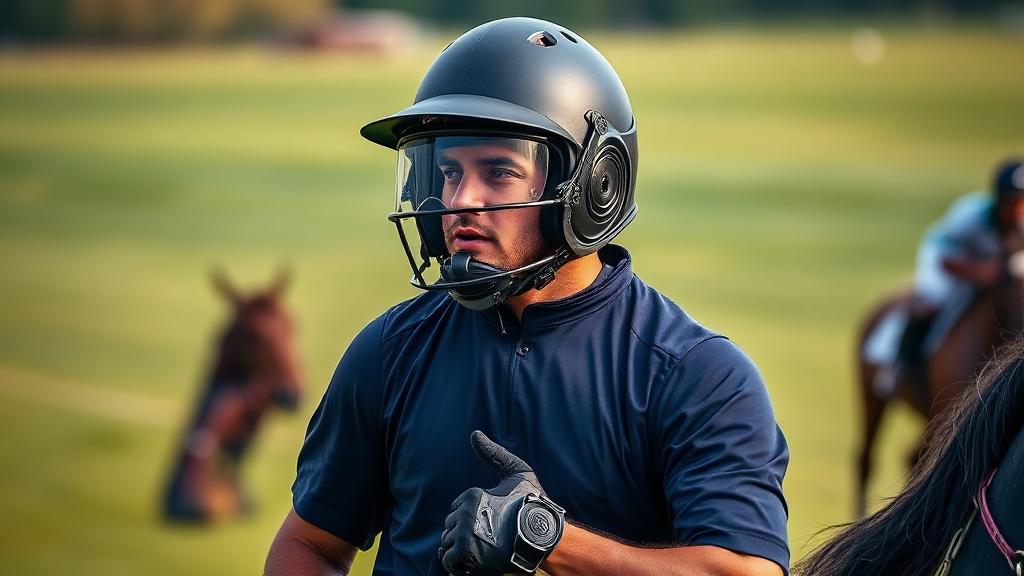
Face guards are not traditional in grass polo and are rarely used. In [arena polo](/glossary/arena-polo), some players — particularly beginners — use face guards. Face guards do not affect the helmet's head protection but add a layer of facial protection in the closer-quarters environment of arena polo.
How do I clean a polo helmet?
Use a damp cloth and mild soap for the exterior. For interior liners, most are removable and washable — check the manufacturer's specific instructions. Avoid harsh chemicals on the shell.
Are second-hand polo helmets safe?
This is a significant caution area. A second-hand helmet may have suffered an impact that is not visible externally but has compromised the foam liner. Without knowing the full history of the helmet, you cannot be certain of its protective integrity. If you do purchase second-hand, buy only from a trusted source with clear knowledge of the helmet's history, and accept that you are taking a risk not present with a new helmet.