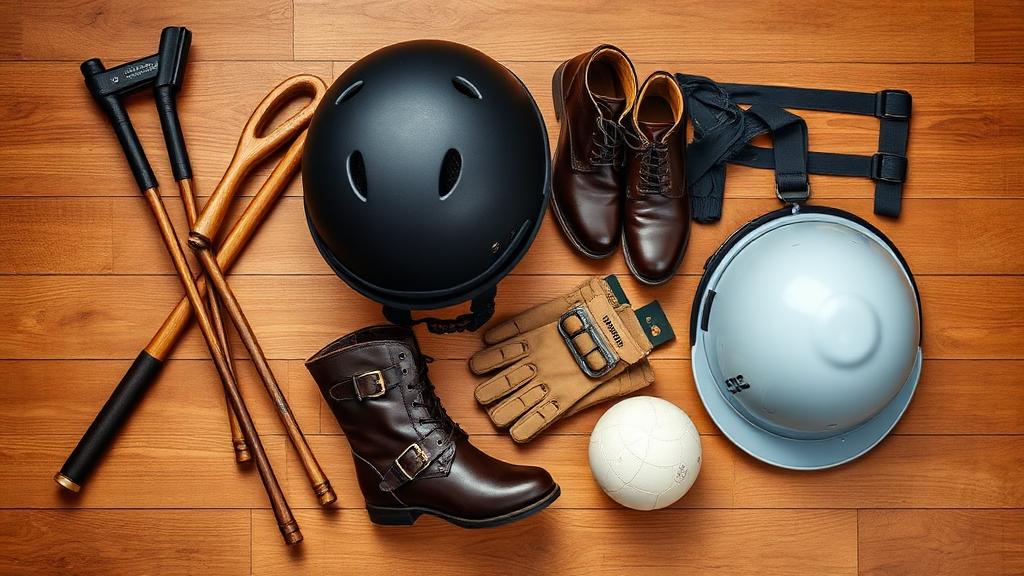
Polo Kit Bag Essentials: The Complete Checklist
Everything a polo player needs in their kit bag, organised by match day, practice, and travel — with tips on organisation, maintenance, and what not to forget.
Polo Kit Bag Essentials: The Complete Checklist
Ask any experienced polo player what they have forgotten at least once on their way to a match — a helmet, a spur, a pair of gloves — and you will hear a story involving an improvised solution, a borrowed item, or a missed chukker. The polo kit bag is a complex system that must carry personal safety equipment, clothing, [mallet](/glossary/mallet) care items, horse care basics, and an assortment of small items whose absence causes disproportionate frustration.
This guide provides a comprehensive, category-by-category checklist for the polo kit bag, organised by the three primary contexts: match day, practice/training sessions, and travel polo. It also covers bag organisation, maintenance, and the items that experienced players add to their standard kit that newer players often discover the hard way.
Why Organisation Matters in Polo
Polo matches move quickly. You typically have a few minutes between chukkers, and the period immediately before a match is compressed with horse preparation, warm-up, and team briefing. Knowing exactly where everything is in your bag — ideally without having to search — reduces pre-match stress and ensures you never play without essential safety equipment because you could not find it in time.
A well-organised polo kit bag system also supports equipment maintenance: you notice when items need repair or replacement before finding out at the worst possible moment.
The Core Kit Bag: Match Day Essentials
Personal Safety Equipment
**Polo helmet** — Never leave home without it. Store in its own protective bag or use a dedicated helmet case for transport. Check the retention system and chin strap before each use.
**Polo knee guards** — Check straps and closures the night before. Carry a spare set of Velcro replacement straps if your guards use Velcro closures — these degrade faster than you might expect.
**Body protector** — If you wear one (strongly recommended), it should be in the bag. Some players wear their body protector for the drive to the club; others change on-site.
**Elbow guard** — If you use one, pack it near the top of the bag so it is easy to put on when changing.
Footwear
**Polo boots or short boots** — Keep these in a boot bag within the main kit bag to avoid leather-to-leather scratching and to contain any mud or moisture.
**Spurs** — Easy to forget. Store in a small zip pouch with your boot bag. Carry a spare set if you use them regularly — spurs are shed on the field occasionally.
**Spare boot laces or zips** — Full polo boots with zip closures are vulnerable to zip failure at inopportune moments. A spare pair of boot pulls and emergency shoe repair tools take minimal space.
Clothing
**White polo breeches** — At least one pair (two is better if your club plays multiple chukkers with breaks). White is effectively universal for competitive polo; some clubs and tournaments have specific colour requirements for shirts.
**Team shirt or polo shirt** — Know your team's colours. If you play for multiple teams, labelling your shirts clearly prevents confusion.
**Base layer / undershirt** — A moisture-wicking base layer makes match play significantly more comfortable in warm conditions. Light compression base layers also provide some muscle support.
**Belt** — Often overlooked. A polo-appropriate belt (non-metallic buckle to avoid horse injury) keeps breeches secure during vigorous play.
**Socks** — Polo socks, or at minimum, long riding socks that provide cushioning in the boot. Short socks in polo boots cause blisters.
**Weather layer** — For cold or wet conditions: a thin gilet or technical jacket that can be worn during warm-up and removed before play.
**Spare shirt** — After a match, particularly in warm conditions, a fresh shirt for the post-match social element is appreciated.
Gloves
**Playing gloves** — Mallet hand glove as a minimum, both-hand gloves if preferred. Carry two pairs — one to play in, one spare in case the first gets wet or torn.
Mallets
**Match mallets** — Your personal set, typically two to four mallets for a match. Carry in a dedicated mallet sleeve or tube — loose mallets in a bag invariably result in grip damage.
**Mallet tape / grip wrap** — For on-site grip repairs or adjustments.
**Spare head** — Advanced players who regularly break heads carry a spare and the tools to make a field repair.
Horse Care Items (Match Day)
While the bulk of horse care supplies live at the yard, a match-day kit bag should include:
**Leg boot and bandage repair tape** — Polo boots and bandages come loose. Adhesive bandage tape for emergency re-securing.
**Fly spray** — Essential in summer, particularly before warm-up.
**Small first aid for horses** — Antiseptic spray for minor cuts, a clean bandage.
**Mallet wax / ball wax** — Applied to the mallet head to maintain the correct surface texture and contact feel with the ball.
Practice Day Additions and Modifications
Practice sessions — stick-and-ball work, team drills, practice chukkers — require a slightly modified kit compared to match days.
Items to Add for Practice
**Older boots and guards** — Many players have a set of older, well-worn equipment for practice sessions to preserve their best gear for competitive play.
**Practice mallets** — Similarly, some players carry older or cheaper mallets for heavy practice use, preserving tournament mallets.
**Extra bandages and polo leg boots** — Practice sessions often involve working young or fresh horses that require more protection.
**Ground poles / cone** — If you are setting up stick-and-ball exercises independently, a few cones or markers for ball positioning exercises.
**Water bottle** — Practice sessions in warm weather can last two to three hours. Hydration is often overlooked.
**Sunscreen** — Polo players spend significant time in direct sun. SPF 30+ applied before practice is sensible.
**Notebook** — Some players keep brief notes on horses' behaviour, equipment adjustments, and coaching points. Review before the next session accelerates learning.
Practice Session Horse Care
**Exercise bandages** — For young horses or those requiring extra leg support during training.
**Lunge line** — If your horses need lunging before mounting.
**Grooming kit** — A basic grooming kit (body brush, mane comb, hoof pick) in the car or truck.
Travel Polo Additions
Travelling to tournaments or polo clubs outside your home club introduces logistical complexity. The travel kit bag extends the standard list significantly.
Extended Clothing
Extended Equipment
**Saddle(s)** — For any tournament involving your own horses, your saddle(s) travel with you. Keep in padded saddle bags.
**Bridles and reins** — Multiple sets depending on your horse [string](/glossary/string). Label everything clearly.
**Saddle pads and numnahs** — Multiple sets; they accumulate sweat and mud rapidly in tournament play.
**Girth(s)** — Check all girths before departure. A girth failure in a match is a serious problem.
**Spare stirrup leathers and irons** — Stirrup leathers can snap under stress. Carry at least one spare set.
**Mallet full set** — All mallets, including those you would not typically bring to club play.
**Spare polo balls** — Some tournaments expect players to provide balls; confirm requirements.
Horse Health and Administration
**Vaccination records** — Many tournaments and clubs require proof of current flu/tetanus vaccination before horses are allowed on the premises.
**Insurance documents** — Horse and third-party liability insurance documentation.
**Emergency vet contacts** — Research local vets near the tournament venue before departure.
**Electrolytes and supplements** — Horses competing in warm conditions over multiple days benefit from electrolyte supplementation; bring your usual products rather than relying on availability at the destination.
**Medication** — Any prescriptions your horses are on. Check for restricted substances if travelling internationally.
For International Travel
**Equine passport / health certificates** — Essential and non-negotiable for international travel with horses.
**Customs documentation** — Equipment lists, saddle serial numbers, mallet inventories for customs purposes.
**Adaptors and travel chargers** — For phones and any electronic devices.
**Emergency kit contact list** — Contact details for your national association, insurance provider, and local embassy if travelling internationally.
Bag Organisation Systems
The Three-Zone System
Many experienced polo players organise their main kit bag using a three-zone system:
**Zone 1 (Top / Quick Access)**: Safety equipment and items needed in the final minutes before mounting — helmet, knee guards, gloves, spur pouch.
**Zone 2 (Middle / Play Ready)**: Clothing in ready-to-wear order, spare gloves, mallet grip tape.
**Zone 3 (Bottom / Support Items)**: Less frequently needed items — spare kit, basic repair tools, horse care items, documentation.
Dedicated Sub-Bags
Within the main bag, dedicated sub-bags prevent chaos:
Pre-Season and Pre-Match Checklists
Many experienced players maintain a printed or phone-based checklist that they run through the evening before a match. The critical items are those most commonly forgotten: spurs, gloves, and in warm weather, sunscreen. Adding five minutes of checklist review the night before eliminates the most common kit emergencies.
Maintenance Calendar for Kit Bag Items
| Item | Frequency | Action |
|------|-----------|--------|
| Boots | After each use | Clean and condition |
| Knee guards | After each use | Wipe down, check straps |
| Helmet | Monthly | Clean, check retention system |
| Gloves | After each use | Hand wash if needed |
| Mallets | After each use | Wipe head, check joint |
| Body protector | Monthly | Check stitching, closures |
| Saddle | After each use | Wipe down, condition weekly |
The Experienced Player's Hidden Arsenal
Beyond the standard checklist, experienced polo players typically carry several items that they discovered the hard way:
**Electrical tape**: Infinitely useful for emergency repairs to boots, bandages, polo wraps, and equipment.
**Cable ties / zip ties**: For equipment lashing emergencies.
**Safety pins**: For collar tabs, shirt repairs, and numbercloth.
**Arnica gel or similar**: Bruising and muscle soreness are part of polo. Having a topical treatment ready accelerates recovery between chukkers.
**Anti-blister stick**: Applied to friction points on the foot and leg before getting into boots.
**Baby wipes**: For rapid horse and equipment clean-up between chukkers when there is no water available.
**Portable phone charger**: Tournament days are long; phone battery management matters.
**Snacks**: Energy demands of polo play are significant. Having high-energy snacks (nuts, energy bars) for between chukkers is standard practice among regular competitors.
**Cash**: Many polo venues have limited card payment options, particularly at rural clubs.
Frequently Asked Questions
How big does my polo kit bag need to be?
For regular club play, a duffel of 60 to 80 litres accommodates all essentials. For tournament travel with full kit, 100+ litres or a second bag for boots and equipment is typical.
What do I do if I forget my helmet at a match?
Most clubs maintain a supply of spare helmets for emergencies. Ask the club manager immediately upon arrival. Never play without a properly fitted, certified helmet — not even for a single chukker.
Should I keep a separate bag for horse care vs personal kit?
At the club level, integration is practical. For tournament play with multiple horses, a separate horse kit box (usually a plastic or wooden storage box kept at the horse float or lorry) is much more practical than packing everything into one bag.
How do I clean polo whites?
Grass stains respond well to pre-treatment with a proprietary stain remover before washing. Wash white polo kit separately to avoid colour transfer. Some players use an enzyme-based soak for particularly stubborn grass stains. For tournament play, having clean whites for each day requires either multiple sets or rapid-turnaround laundry.
What is the right way to pack mallets for travel?
A rigid mallet tube (available from polo suppliers) provides the best protection during transport. Soft mallet sleeves are adequate for car transport but offer minimal protection in aircraft hold or courier shipment.
Is there insurance-relevant documentation I should carry?
Yes. Your personal liability insurance policy number (or club confirmation of coverage), your horse(s)' insurance details, and any relevant medical insurance if travelling internationally for polo. Keep digital copies in addition to paper copies.
Can I bring my polo kit as hand luggage on flights?
Mallets will always need to be checked. Most other polo kit can travel as hold luggage. Check airline policies on polo boots (due to spurs) and body protectors. Some airlines categorise body protectors as sporting equipment subject to additional fees.