The Right of Way Rule Explained: Polo's Most Important Rule
The right of way is the foundation of polo's safety and strategy. Learn how this critical rule works, why it exists, and how to use it to your advantage on the field.
The Right of Way Rule Explained: Polo's Most Important Rule
If you learn only one rule of polo, make it the right of way. This single concept governs almost every umpiring decision, determines which fouls are called, and — most importantly — keeps players and horses safe at high speed.
What Is the Right of Way?
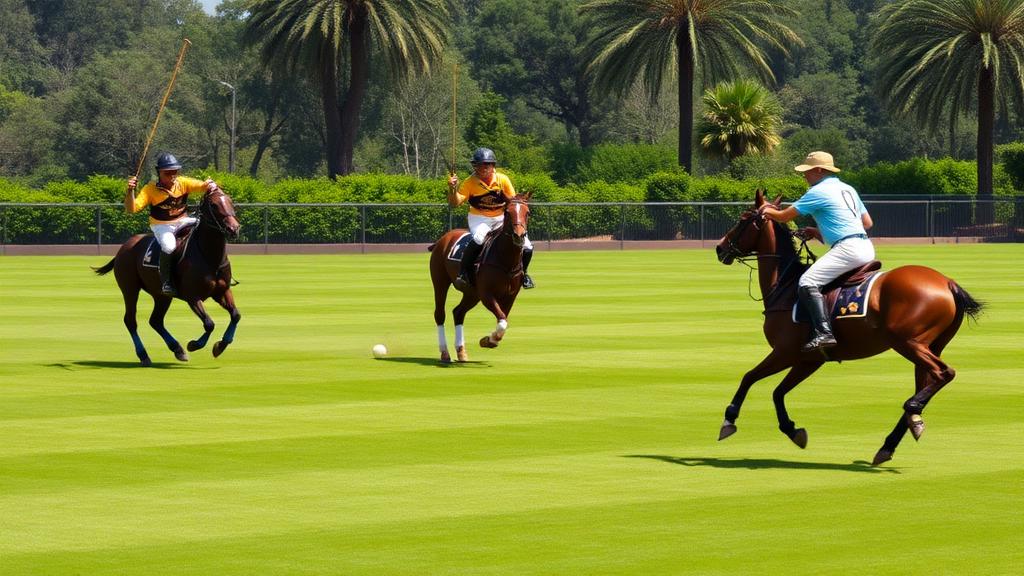
The right of way is the imaginary [line of the ball](/glossary/line-of-the-ball)'s path after it has been struck. The player who hits the ball, or who is riding closest to this line on the correct side, has the right of way. No other player may cross this line if doing so creates a risk of collision.
Think of it like a motorway: the ball creates a lane, and the player following it has priority. Everyone else must yield, just as you would to a vehicle already in a lane.
How It Works in Practice
When a player hits the ball, the line of the ball extends forward from where the ball was struck in the direction it is travelling. The player who hit the ball (or the player riding in the same direction as the ball on the exact line) has the right of way.
**Key principles**:
1. **The line belongs to the hitter**: After striking the ball, the player who hit it has the right of way along the ball's trajectory
2. **Approaching from the correct side**: Other players can challenge for the ball, but they must approach from the side that does not cross the line dangerously
3. **Speed and angle matter**: A player [crossing](/glossary/crossing) the line at a shallow angle with time to spare may not commit a foul, but crossing at speed or at a sharp angle will be penalised
4. **Both directions apply**: The line extends in both directions from the ball — you cannot cross from either side
Why Does It Exist?
Polo is played at speeds up to 50 km/h (30 mph). Horses weigh 400–500 kg. At these speeds and masses, collisions can be catastrophic for both horses and riders. The right of way rule exists to prevent head-on and T-bone collisions by establishing clear priority.
Without this rule, two players galloping at full speed from different angles toward the same ball would risk a direct collision. The right of way creates order from potential chaos.
Common Violations
Crossing the Line
The most frequently called foul. A player rides across the path of the ball in front of a player who has the right of way. The severity depends on:
Pulling Up into the Line
A player pulls up their horse directly in the path of a player with the right of way. Even though there's no crossing per se, blocking the line is equally dangerous because the trailing player cannot stop in time.
Sandwich Play
Two players from the same team ride on either side of an opponent with the right of way, compressing space and creating a dangerous situation. This is typically penalised as a foul against the player who created the dangerous compression.
How Umpires Apply It
Two mounted umpires officiate polo matches, riding alongside the play. They assess right of way violations in real time — a demanding task given the speed of the game.
When a foul is called, the severity determines the penalty:
The key factor in penalty severity is always **danger**, not advantage. A foul that creates danger will be penalised more harshly than one that merely creates an unfair advantage.
Strategic Use of the Right of Way
Understanding the right of way isn't just about avoiding fouls — it's a strategic weapon:
**Creating the line**: Skilled players hit the ball in directions that give them favourable right of way positions. By choosing where the ball goes, you choose who has priority.
**Riding the line**: Once you have the right of way, ride it confidently. Hesitation invites opponents to take the line from you. Commit to your path and trust that opponents must yield.
**Forcing fouls**: Experienced players can set up situations where opponents are almost compelled to foul. By hitting the ball across an opponent's path and then riding the line, you can draw penalties in advantageous positions.
**Defensive awareness**: Understanding the right of way helps defenders position themselves legally. Instead of crossing the line, a good defender rides alongside and uses the [ride-off](/glossary/ride-off) (a legal body check, shoulder to shoulder) to challenge for the ball.
Common Misunderstandings
**"I was there first"** — Priority is about the line of the ball, not who reached a spot first. Even if you've been standing in a position, if another player hits the ball and creates a line through your position, they have the right of way.
**"I was going straight"** — Travelling in a straight line doesn't give you the right of way. It's the ball's line that matters, not your horse's direction.
**"I didn't touch the other player"** — A foul doesn't require contact. Creating a dangerous situation by crossing the line is a foul regardless of whether a collision actually occurred.
Tips for Beginners
1. **When in doubt, pull off the line**: It's always better to yield and lose position than to cause a dangerous play
2. **Watch the ball, not the player**: The ball determines the line; everything else follows
3. **Listen to your umpire**: If they're calling fouls frequently, you're probably misjudging the line. Ask after the match for clarification
4. **Practice spatial awareness**: Before worrying about hitting the ball well, learn to see the line and position yourself correctly
The right of way is polo's safety net. Master it, and you'll play safer, smarter polo — and earn the respect of every player on the field.